- Selling
- Buying
- Landlords
- Renting
- New homes
- House prices
- International services
 International offices
China, Hong Kong SAR, India, Indonesia, Malaysia, Middle East, Pakistan, Qatar, Singapore, Thailand and Turkey
Learn more - News
- Contact
- About us
- My B&R


 Free online valuation
Home News
Landlords news
Legionella Risk – Landlords warned over ‘invisible’ Legionella risk as summer heat hits London
Legionella Risk – Landlords warned over ‘invisible’ Legionella risk as summer heat hits London
- Landlords news
- 24.08.26
- Marc von Grundherr
|
Getting your Trinity Audio player ready...
|
Contents
- What is Legionnaires’ disease – and how dangerous is it?
- Could there be Legionella in your rental property?
- Do landlords need a Legionella risk assessment?
- Is Legionella risk assessment a legal requirement?
- Does the Renters’ Rights Act cover Legionella?
- How often should landlords carry out an assessment?
- Empty properties can be a particular concern
- Who can carry out a Legionella assessment?
- What should London landlords do now?
- Which rental properties face the greatest risk?
- Don’t wait for a tenant to report a problem
- How professional property management can reduce the risk
Legionella can cause severe — and sometimes fatal — pneumonia. With prolonged summer heat, vacant properties and stagnant water potentially creating favourable conditions for bacteria to multiply, London landlords are being urged not to overlook a hidden risk inside their properties.
As temperatures rise across the UK, water safety is becoming an increasingly important issue for landlords.
Legionella bacteria can multiply in poorly managed water systems, particularly where water is allowed to stagnate or sit at temperatures between 20°C and 45°C. The danger is that there may be no obvious warning signs before contaminated water droplets are released from a shower, tap or other outlet and inhaled.
Earlier this year, the UK Health Security Agency (UKHSA) investigated several confirmed and suspected cases of Legionnaires’ disease linked to an outbreak affecting North West and South West London.
For landlords, the message is simple: Legionella is not a risk to ignore just because a property looks clean or has never had a previous problem.
A spokesperson at Legionella Guard, a Legionella assessment agency for landlords, warned: “Tighter enforcement under the Renters’ Rights Act means landlords cannot afford to treat Legionella risk as just a tick-box exercise this summer.”
What is Legionnaires’ disease – and how dangerous is it?
Legionnaires’ disease is a serious form of pneumonia caused by inhaling tiny airborne droplets of water contaminated with Legionella bacteria.
Showers, spray taps and other water outlets can produce the fine droplets through which infection can occur.
The bacteria thrive where water systems provide the right conditions, particularly:
For some people, the consequences can be extremely serious.
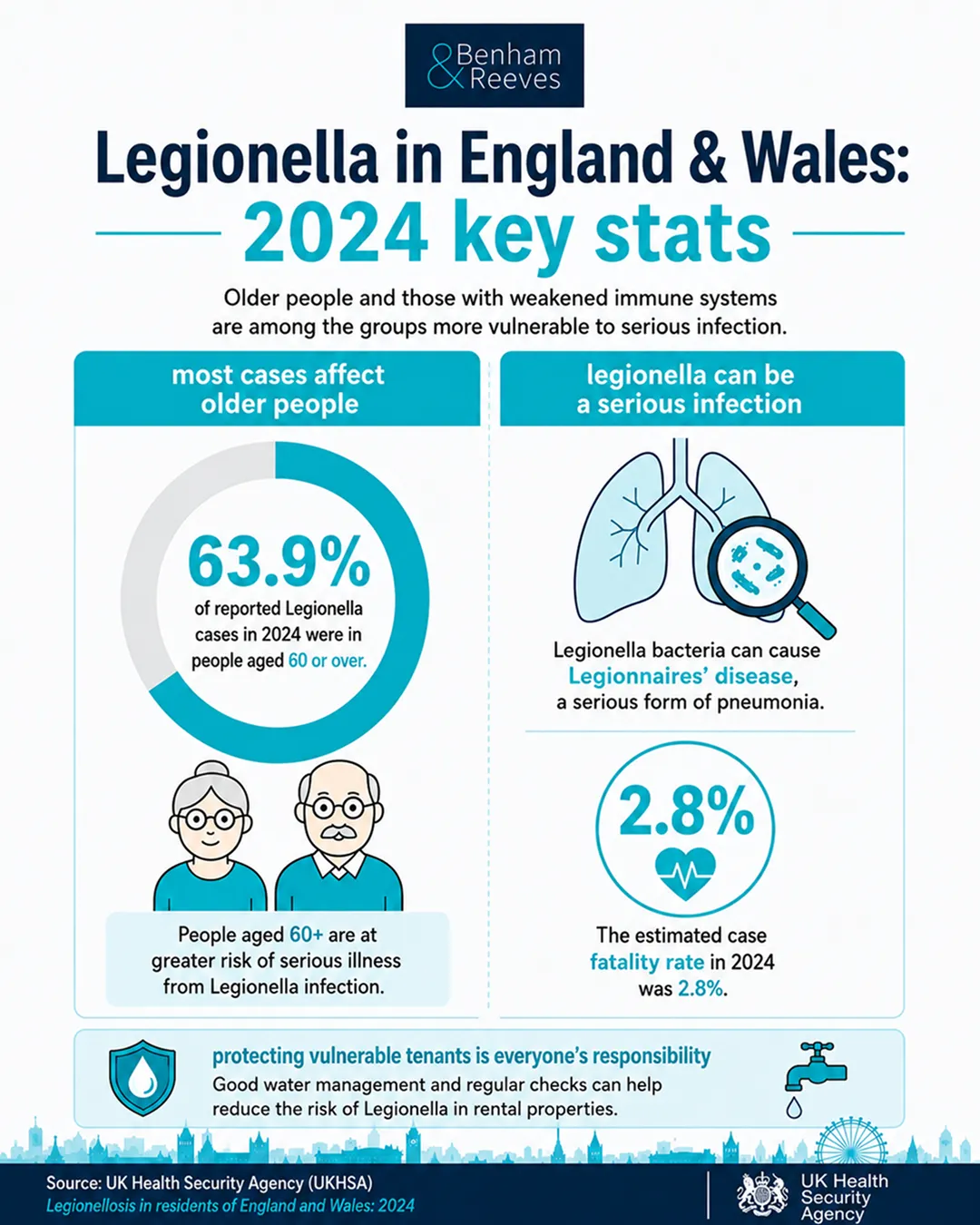
Older people and those with weakened immune systems are particularly vulnerable. In 2024, 63.9% of reported cases in England and Wales involved people aged 60 or over, while the estimated case fatality rate was 2.8%.
That means Legionella should be treated as more than a minor maintenance concern. In the wrong circumstances, a neglected water system can become a genuine health hazard.
Could there be Legionella in your rental property?
Potentially, yes. Legionella bacteria occur naturally in water and can become dangerous when a plumbing system allows them to multiply. A property that has been empty for several weeks, for example, can present greater risk because water may have been sitting unused in pipes, tanks and outlets.
This can be particularly relevant for London landlords with:
A property does not need to look neglected for a risk to develop.
Do landlords need a Legionella risk assessment?
Yes. Landlords have a legal responsibility to assess and control the risk of exposure to Legionella. According to guidance from the Government’s Health and Safety Executive (HSE), landlords must identify potential sources of risk and take appropriate steps to prevent or control them.
For a typical London flat or house with a simple, frequently used mains-fed water system, the assessment may be relatively straightforward and conclude that the risk is low. However, “low risk” should be the outcome of an assessment — not an assumption.
Is Legionella risk assessment a legal requirement?
Landlords must assess and control the risk, although there is no universal requirement to obtain a specific “Legionella certificate”.
You can obtain a formal certificate after a professional assessment or microbiological water sampling, but laboratory testing is not automatically required for ordinary domestic hot and cold water systems.
The key point is that landlords must be able to demonstrate that they have considered the risk and managed it appropriately. Ignoring the issue altogether is not a safe approach.

Does the Renters’ Rights Act cover Legionella?
The Renters’ Rights Act does not create a specific requirement for landlords to obtain a “Legionella certificate”. However, the wider direction of rental reform is towards greater scrutiny of housing conditions and stronger consequences where landlords fail to provide safe homes.
That makes documenting safety checks and responding quickly to identified hazards increasingly important. Landlords should therefore avoid thinking of Legionella as simply another administrative exercise. The potential consequences involve not only compliance, but tenant health.
How often should landlords carry out an assessment?
Unlike gas, fire and electrical safety checks, there is no fixed annual timetable for Legionella assessments. However, HSE guidance says landlords should review the assessment periodically and whenever circumstances change.
Landlords should pay particular attention after:
A property that was low risk two years ago may no longer be low risk if its occupancy or water system has changed.
Empty properties can be a particular concern
One of the most easily overlooked risks is stagnant water. When a rental property sits empty, water can remain in pipes and outlets for prolonged periods. If the temperature is also favourable for bacterial growth, conditions can become more conducive to Legionella.
HSE recommends using outlets on hot and cold water systems at least weekly, where appropriate, to reduce stagnation.
For landlords with vacant properties, simply locking the door and waiting for the next tenant may therefore not be enough.
Water systems may need active management during the void period and flushing before a new tenancy begins.
Who can carry out a Legionella assessment?
For straightforward domestic properties, landlords may be able to carry out a basic assessment themselves, provided they are competent to identify and manage the risks.
However, where a system is more complex — or where a landlord is uncertain about the condition of tanks, pipework or water temperatures — using a competent professional can provide greater reassurance.
Specialist assessments can be particularly worthwhile in older properties, larger buildings and homes with stored water or unusual plumbing configurations.
What should London landlords do now?
Benham and Reeves Director Marc von Grundherr says landlords should focus on one fundamental principle: “Keep hot water hot, cold water cold and water moving.”
HSE recommends storing hot water at around 60°C, flushing water systems before letting a property, removing unnecessary or redundant pipework and ensuring cold-water tanks are properly covered and maintained.
Properties left vacant require particular attention.
Where appropriate, use or flush outlets regularly to reduce stagnation, and landlords should watch for parts of the water system that become unusually warm.
Water tanks or pipework exposed to strong sunlight or excessive heat can warm up, potentially bringing water into the temperature range in which Legionella bacteria can multiply.
This makes summer a particularly sensible time to review properties with:
Which rental properties face the greatest risk?
Not every rental property presents the same level of danger. Greater care may be required where there is:
The more opportunities warm, stagnant water has to develop, the greater the need for careful management.
Don’t wait for a tenant to report a problem
Legionella is particularly concerning because landlords cannot rely on a tenant spotting the danger. Contaminated water may look completely normal. There may be no unusual colour, smell or visible indication that bacteria have multiplied inside a water system. By the time illness occurs, you’ve already missed the chance to prevent exposure. That is why prevention, sensible maintenance and proportionate risk assessment matter.
How professional property management can reduce the risk

Professional property management can help London landlords identify potential Legionella risks before they develop into more serious problems. Experienced property managers can arrange proportionate risk assessments, monitor water systems, organise maintenance and ensure vacant properties are appropriately managed.
They can also identify warning signs such as stagnant water, poorly maintained tanks, redundant pipework or long-unused outlets and arrange remedial work where necessary.
They can also identify warning signs such as stagnant water, poorly maintained tanks, redundant pipework or long-unused outlets Our team can assist with property maintenance and arrange remedial work where necessary.
Crucially, good property management also creates a clear record of the steps taken to protect tenants. With health and safety obligations facing increasing scrutiny, that documentation can be almost as important as the inspection itself.
Legionella may be invisible, but the consequences of ignoring it can be anything but.
Contact us to learn more about health and safety risks associated with property lettings and management in London.
 Add Benham and Reeves as a preferred source on Google.